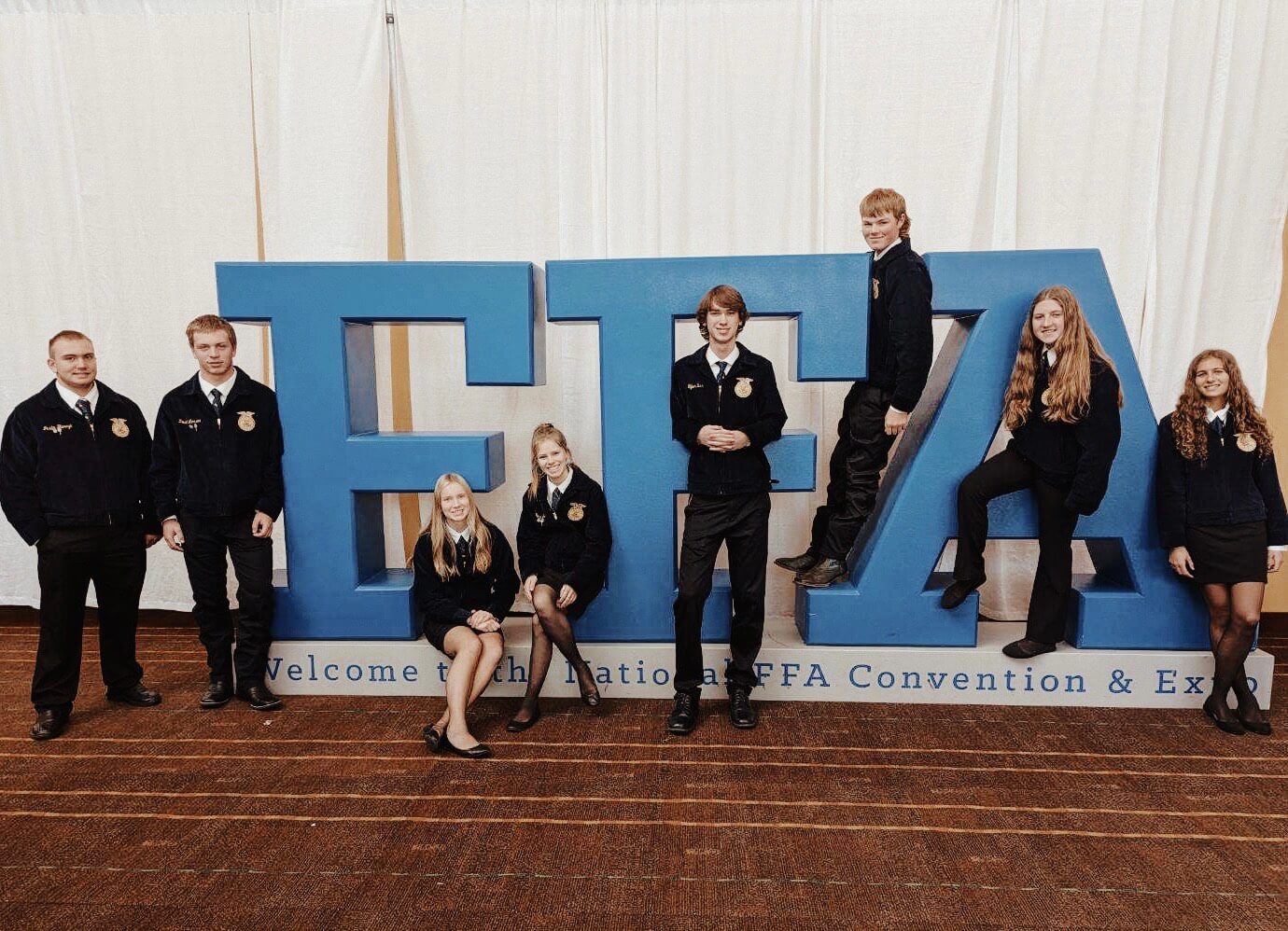
Students above from right to left: Alexa Blume, Aubrey Schroeder, Landon Long, Tyler Biss, Jaime Johnson, Addison Blume, David Larson, Justin Blascyk.
“Our students are the next generation who will be in charge of our land, water, and air,” wrote Mr. Eric Sawatzke about his classes as the agriculture teacher at West Central Area Secondary School. “With each new generation comes better ideas of how to produce more food while using less resources, and our students are focused on keeping the world fed and fueled, while also reducing inputs such as fertilizers and pesticides. Our students develop an understanding that protecting their soil is the best long-term sustainability measure they can take.”
When I spoke with one of his students, Jaime Johnson, FFA Chapter President, those teachings were heard clearly. FFA is a network supporting the next generation of farmers, who will need to meet the challenges of farming in a changing climate. I asked Johnson how her chapter of FFA prepares students to meet that challenge.
“We learn about Norman Borlaug, the father of the Green Revolution, and his influential role in curbing world hunger and saving billions of people from starvation. We also learn how climate change ties into the problem of food security,” said Johnson. “Being engaged with our family farms, we can see the challenges we already are facing. Learning about them in our classrooms and piecing together ‘why is this happening?’ – that is how we prepare to farm in a changing climate.”
Eight chapter members, including Johnson, recently returned from the 95th National FFA Convention held in Indianapolis this year. They met and took pictures with students from almost every state, even meeting FFA members from Puerto Rico and the Virgin Islands. “Half the students are there to compete, and the other half are there to just have fun, learn, and network with people from all across the country,” said Johnson.
Johnson competes in a career development event called farm business management. “When I first started competing, I wasn’t sure if I wanted to stick with it. It seemed so overwhelming!” said Johnson. “But, once I dug into the content, I got really excited because this is what I want my future to be based around – managing our family farm.”
Farming for future generations is not just a passion for Johnson, it’s in her bones. “I’m a fifth-generation farmer. Since the first generation, we’ve always been wanting to conserve the land. Our whole mindset is to make sure the land is in good shape, and we’re not wasting anything,” said Johnson, acknowledging the unintentional legacy of some industrial ag practices in degrading soil health. “Recently, my dad and I have been looking into no- or less-tillage farming because when tillage equipment came out, I think people hammered the ground a lot more than they should have.”
In the last four to five years, Johnson’s family started using Salford’s tilling equipment, which is less harmful to the soil health than a chisel plow. “Instead of ripping the dirt, and turning it over so bad that all the nutrients and organic matter disappear, the Salford only works the top most layer,” said Johnson. They’ve also been implementing cover crops – turnips and radishes, as well as rye on the fields where we grow wheat.
Last summer, during an internship with Red River Marketing, Johnson practiced scouting fields, performing soil samples, and flying drones to map data that helps minimize fertilizer and chemical use, all techniques she brings to her farm home.
“Farmers want to conserve the land as much as possible, and agriculture really is our passion,” Johnson concluded. “If we don’t protect our soil, we won’t be able to farm, and that’s what we live to do. We’re just trying to make a living and feed the world – no small task indeed.”
About the Author

Benjamin Velani is the Lead for America Climate Fellow and serving AmeriCorps member at West Central Initiative. He recently graduated Summa Cum Laude from Cornell University, majoring in Religious Studies and Government and writing an undergraduate thesis on the human and ecological effects of light pollution and dark night skies. He was formerly the Dining Editor at The Cornell Daily Sun, and he’s now taking the lead on West Central Initiative’s Climate Action Newsletter.