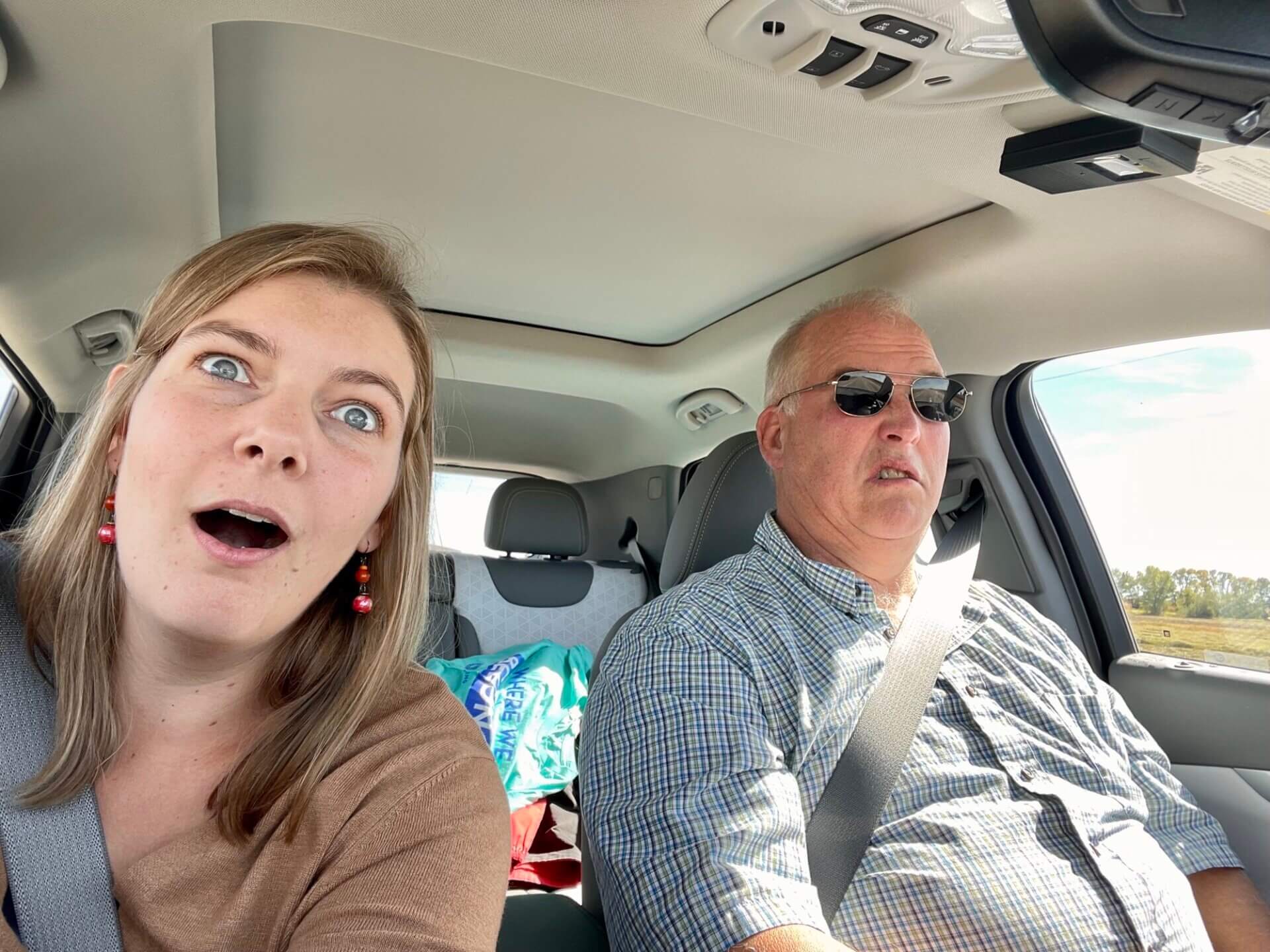
Last week, while zooming down I-94, our Community Engagement Specialist Rick Schara and I successfully experienced “range anxiety.” Wikipedia describes this as “the driver’s fear that a vehicle has insufficient energy storage (fuel and/or battery capacity) to cover the road distance needed to reach its intended destination.” I describe it as “fear of being stuck on the side of the road in rural Pope County while missing all of our afternoon meetings.”
The day started with our West Central Initiative Chevy Bolt fully charged for a 250-mile journey. We planned to head towards New London and stop in Alexandria to charge at the DC fast-charging station on the way back to Fergus Falls—a total of 164 miles until we planned to charge. The anxious feeling of a draining battery set in as we approached Sauk Center and noticed the range declining rapidly for the reasonable 71-mile trip from Fergus Falls to New London. The fast speed, air at full blast, and classic rock playing in the background had undoubtedly taken a toll on our charge. Then, we hit a few detours unannounced by our GPS. Our morale began to drop along with the projected miles left until we needed to charge.
Will We Make It?
“What about the charging apps, the ones that show all available EV chargers?” Rick suggested. “Call the utility and power companies. Perhaps they could give us a charge if need be.” We found no luck there. The embarrassment of having to call Triple A, or even worse: a tow truck, fueled our drive to problem-solve. As we further brainstormed how to keep our ship afloat, we had two fruitful phone calls: the New London Library, which reached out to a local EV owner in case of emergency, and Marthaler Chevrolet of Glenwood, which kindly offered that we could stop and charge our battery enough to reach Alexandria. So, we went into our lunch meeting in New London with Plan A, Plan B, and Plan C.
While telling our lovely Southwest Initiative Foundation and Welcoming America colleagues about our predicament, a couple at a nearby table politely interrupted and informed us about two new charging stations nearby: a station in Wilmar and a hotel in Spicer. They cheered us on and explained that they were waiting for their new EV to be delivered. “If we had our charging cords already, we would help you out!”
We Made It!
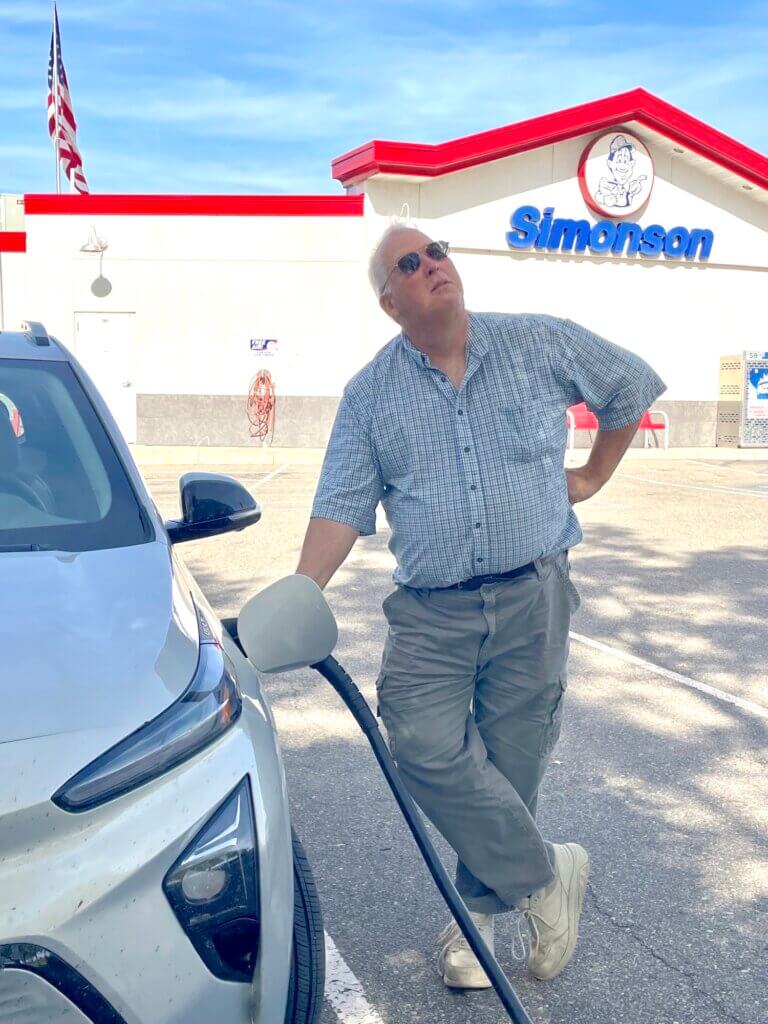
We jumped back on the county highway to Glenwood, and even though we hit another detour, the braking and slower speeds prolonged our battery life. We made it all the way back to the fast charger at Simonson in Alexandria without making an emergency stop to charge after all. We celebrated the success with some pie at Perkins and replaced our range anxiety with some pumpkin spice. Over pie, we formulated clear conclusions: driving an EV in rural Minnesota takes extra planning and precaution, but small-town Minnesota holds true—when you find yourself in need of a little help, your neighbors are willing to give a lot of it. Ultimately, neighborliness is what allows rural areas to benefit from new technology that is more widely available to residents in larger cities.
Learn More About EVs
The Minnesota Department of Transportation, in partnership with the federal government, plans to invest $68 million over the next five years through the Electric Vehicle Infrastructure Plan. That means less range anxiety, fewer carbon emissions, and more miles available for us to carry out community development. If you’re interested in learning more about EVs—especially as driving an EV becomes more accessible—I encourage you to attend the Lakes Area EV Event in Detroit Lakes on October 15. You’ll be able to test drive vehicles, hear from speaker Paul Douglas, and, most importantly, connect with a community of EV enthusiasts in west central Minnesota.