In conversations around business-smart climate adaptations, someone usually brings up the often sizable initial investment needed to, say, install solar panels on the roof and tie them into the grid. How long will it take to recover that investment in tax credits and monthly dividends? One Starbuck auto body shop owner tried it and has been saving real money since.
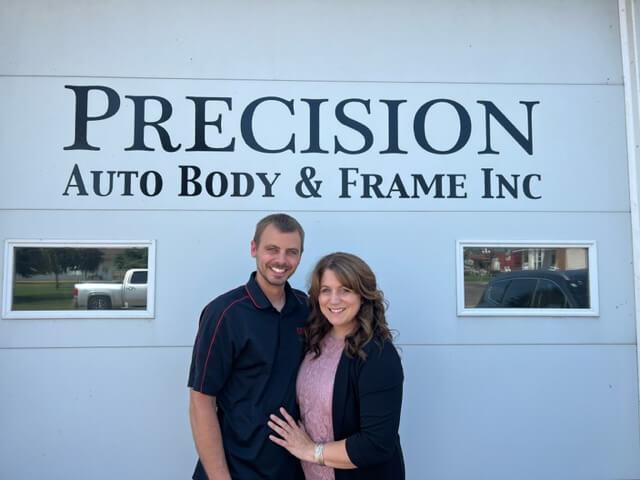
Chris Taffe, whose last name rhymes with safe, opened Precision Auto Body and Frame Inc. in May of 2012. “I had been working in body shops since I graduated tech school in ’06, and I’ve always been wanting to have my own shop,” Taffe said. “My current shop was just 20 minutes from where I had been working, so after I looked at it, got a business plan together, and got all the financing lined up, I just jumped in and started.”
Taffe is married to Kristie, who worked as a veterinarian technician in Alexandria before they started the shop. “Kristie has always been supporting me in what I wanted to do. We met in tech school, and owning my own shop was something we had talked about. She had always been wanting me to pursue that dream.”
Again together, they volunteered to be members of West Central Initiative’s Climate Action Planning Team. “We’ve always wanted to take care of the environment,” explained Taffe. “We can see the changes, so we don’t want to be ones to cause any more detriment to the environment. We’ve always been very conscious of what we’re doing.”
Being conscious of how his business impacts the environment, especially as a servicer of automobiles, starts with what products Taffe uses for his work. “When I started the shop, I began by using — and I continue to use — waterborne paint instead of solvent- or oil-based paint,” Taffe said. “Waterborne paints, which have been used in car factories since the 90s, don’t require as much or as toxic of solvents to clean up, minimizing the off-gassing of Volatile Organic Compounds. Solvent paints also emit a lot more fumes.”
Taffe’s business-smart climate adaptations stand taller than his roof, where in 2017 he installed a solar array. He’s got 32 panels on top of his shop that runs north to south. “Even without my shop having the optimum south facing slope, I’m still able to produce more electricity than I use,” Taffe said. The panels face west to get the most sun and so electricity production throughout the year.
“In 2017, Xcel Energy’s program allowed you to build a solar array that covers 120 percent of your year’s usage of electricity based on averages calculated from your previous year’s statements,” Taff explained. Taffe said he consulted with a company called All Energy Solar that sent a technical assistant for free designing and implementing the grid-tied array. The Xcel Solar*Rewards® program still exists, offering opportunities for different income-qualified entities.
The monthly rebate checks Taffe receives in the mail from Xcel for being a grid-tied electricity producer vary seasonally, but they’ve already paid back his initial investment, which was expected to take seven to eight years. It took Taffe only six. “In the summer right now, I’m producing well over the electricity I can use in the shop. Same in the spring and fall, so I get rebate checks that are sometimes up to $200 a month,” Taffe said.
“In the winter, when production goes down, I pay around $50 a month. But it all offsets in the long run,” Taffe said. “The rising cost of electricity as our county makes its transition to clean energy has made my rebate checks almost double.”
Taffe, a forward-thinking father, recognized which way the energy market is going, and that’s how business-smart climate adaptations saved one Starbuck auto body shop real money.
About the Author

Benjamin Velani is the Lead for America Climate Fellow and serving AmeriCorps member at West Central Initiative. He recently graduated Summa Cum Laude from Cornell University, majoring in Religious Studies and Government and writing an undergraduate thesis on the human and ecological effects of light pollution and dark night skies. He was formerly the Dining Editor at The Cornell Daily Sun, and he’s now taking the lead on West Central Initiative’s Climate Action Newsletter.