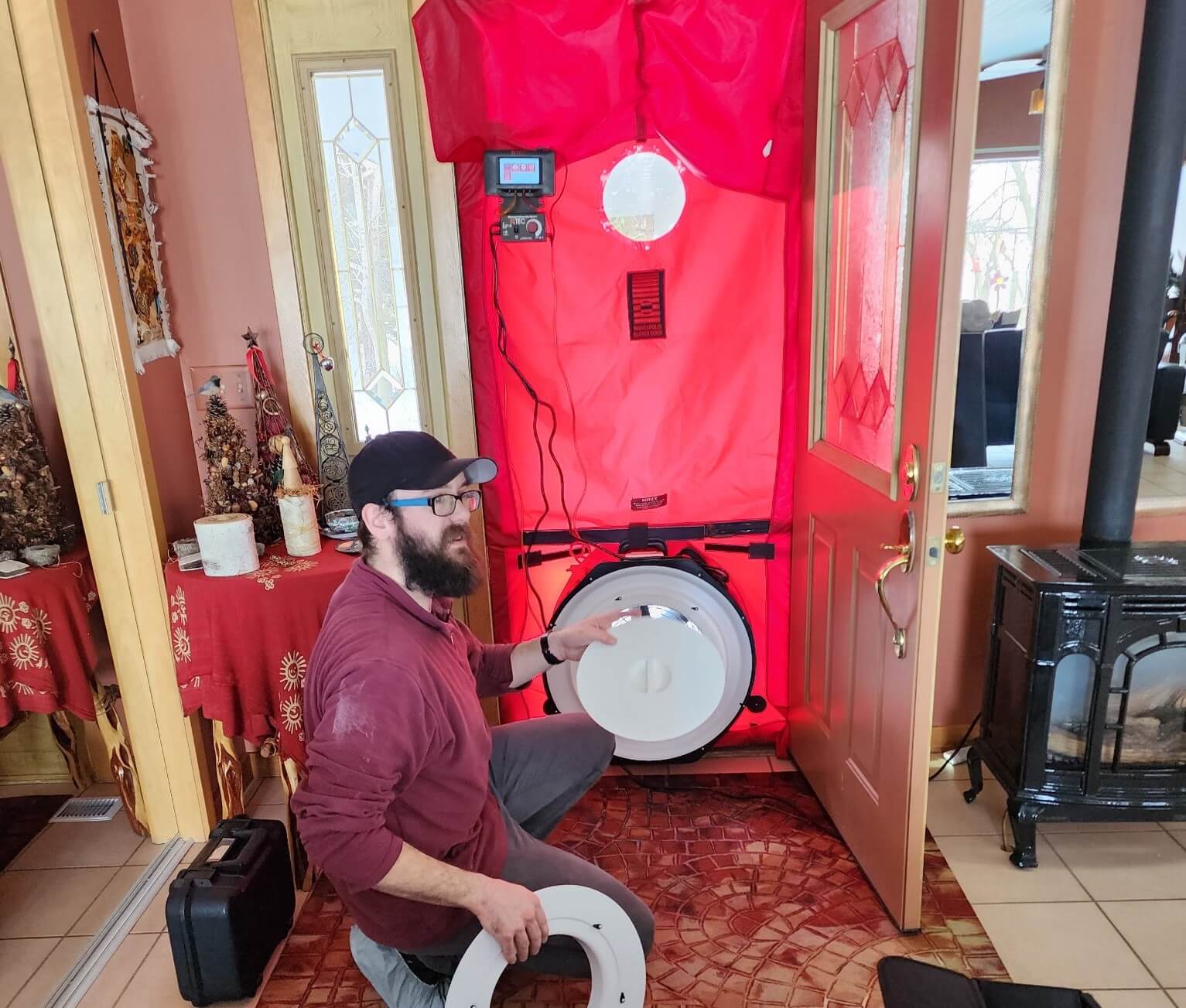
Joshua DeLarbre is a current Climate Impact Corps member serving at West Central Minnesota Communities Action (WCMCA) in Elbow Lake. DeLarbre conducts energy loss audits for income-eligible residential clients as a part of WCMCA’s Weatherization Program. The point of conducting an audit, according to DeLarbre, “is to lower your utility bills.”
The Weatherization Program is available to homeowners, renters, those living in mobile homes, as well as other types of homes, and low-income residents of Clay, Douglas, Grant, Norman, Pope, Stevens, Traverse and Wilkin Counties who qualify for the Energy Assistance Program. Targeted groups, who are the first to receive weatherization services based on the priority system, include the elderly, handicapped, high-energy consumers, and households with small children.
DeLarbre got his start in the field when he joined the Navy’s Construction Battalions, known as the Seabees, after graduating from Hastings High School. He served a tour in Afghanistan, building bases for the Marine Corps, and a tour in Japan doing humanitarian work, building schools and sidewalks. For the last decade, DeLarbre worked construction in and around Ashby, where he lives with his wife and eight kids.
“The purpose of an energy audit is to identify the work that can be done in a home to save its owners money lost by energy and fuel waste,” said DeLarbre. “Weatherizing a home means doing things such as spray foaming around your dryer’s vent so cold air doesn’t seep in during the winter. It can also mean properly sealing chimneys, gas and water lines, updating windows, doors, or heating and cooling systems.”
Air infiltration is when unwanted air comes into a home, causing the homeowner to burn more fuel or use more energy to maintain a temperature. Infrastructure built before builders knew how or had the technology to properly seal a home is the cause.
To measure air infiltration, DeLarbre uses cameras and tools to visualize where air is moving to and from in a home. “We attach a blower-door to an exterior door and de-pressurize the house. This causes air to start coming into the house, and that’s when I go around with my infrared camera to see where leaks are coming from.”
DeLarbre explained that for a homeowner, the process of an energy audit is hassle-free. “It takes me roughly four hours to complete an audit and requires no work on behalf of the owner. Clients can leave during the audit, if they wish, and there are just a few papers to sign when I’m done. After, I input all the data collected during the audit into a program, which tells us what we can and can’t do and how much it’ll cost. Not only will you be saving money on your utility bills, but you’ll also be reducing your carbon footprint.
For more information about WCMCA’s Weatherization Program, contact Steph H. at 216-685-4486.
About the Author

Benjamin Velani is the Lead for America Climate Fellow and serving AmeriCorps member at West Central Initiative. He recently graduated Summa Cum Laude from Cornell University, majoring in Religious Studies and Government and writing an undergraduate thesis on the human and ecological effects of light pollution and dark night skies. He was formerly the Dining Editor at The Cornell Daily Sun, and he’s now taking the lead on West Central Initiative’s Climate Action Newsletter.