Sometimes known as “fly-over” states, you might be surprised to learn that Vincent Van Gogh first garnered national fame in Midwestern art museums. Rita Braver featured Van Gogh’s history of popularity in the States for CBS Sunday Morning. In Braver’s story, you can see “Olive Trees,” an original 1889 Van Gogh on display at the Nelson-Atkins Museum of Art in Kansas City.
I was lucky to visit the Nelson-Atkins on a rainy afternoon in April 2023. I was brought by my colleague Tayton Majors. We’re both service fellows with Lead for America, “a national nonprofit organization focused on building a leadership force of moral, dynamic, and locally-rooted leaders committed to serving the communities they call home in every corner of this country.”
Majors serves as the business retention and expansion manager for Bourbon County Regional Economic Development Inc, and curated my time in Kansas. We were engaged in a cross-country fellow exchange program, so for half a week Majors hosted me in his home state of Kansas, then we traveled to Minnesota for me to do the same.
Time in Fort Scott
Fort Scott, in southeastern Kansas, is a small and historically rich town of roughly 7,500. The seat for Bourbon County, Fort Scott is a manufacturing hub with a vibrant main street paved with bricks made right in town over 100 years ago. Fort Scott Brick Company bricks started being manufactured in 1880 and were used to construct many of the stately buildings lining Main Street today.
Steffen Reals for KSN16 reported how the dense, reddish clay unique to this part of the Midwest makes the most durable bricks. Known nationally for this quality, Fort Scott bricks were used in the construction of the Panama Canal and the Indianapolis Speedway. Such histories are often kept local, going unsung at the regional or national levels.
Lowell Milken, founder of his namesake Center for Unsung Heroes in Fort Scott, was inspired to address this issue of unsung histories by a National History Day project undertaken by three high school students from Uniontown, Kansas, a nearby town. Megan Stewart, Elizabeth Chambers, and Sabrina Coons, investigating a 1994 clipping from “U.S. News and World Report,” uncovered the miraculous story of Irena Sendler. Sendler saved more than 2,500 Jewish children during the Holocaust.
Born and raised in Fort Scott, Majors offered this of his planning efforts for our time there, “Living here so long offers me the unique ability to not only know those driving forward the community right now, like the Lowell Milken Center, but also the longstanding organizations that have been so beneficial to our community, like the Gordon Parks Museum.”
Gordon Parks, born in Fort Scott, was sent to St. Paul at the age of 16, after his mother passed away. From Minnesota, Parks launched a long and successful career as a Renaissance man, writing books, composing symphonies, and directing films like “Shaft.”
Under no dire circumstance, Majors and I headed for Minnesota too.
Time in Fergus Falls
While not completely different communities, Fort Scott, Kansas, and my host town of Fergus Falls, Minnesota, have a few notable differences, though share many more commonalities. Roughly twice the population, Fergus Falls enjoys a busier main street and more diversified economy. Start-ups with innovative business models, like sustainable farmstead cheesemaking or 24/7 unstaffed grocery stores in rural food deserts, are being intentionally incubated in the region and funded through organizations like Greater Fergus Falls and my host site, West Central Initiative.
Knowing Majors is committed to fostering economic development in Fort Scott, I structured our time in Fergus Falls around the people and organizations successfully and sustainably developing west central Minnesota, culturally and economically. We had lunch at Sone’s Asian American Cuisine doing business out of the VFW in Pelican Rapids, Minnesota, with the town’s mayor, Brent E. Frazier.
Pelican Rapids has rapidly become a culturally diverse hub, with New Americans bringing in new businesses and tastes. Pho can be enjoyed in this small-town VFW, where many of the vets coming in served in Vietnam, and halal foods can be bought with ease for the many Muslim residents. Creating rural belonging for migrating populations is only going to become more important as climate change forces people from their homes.
It’s in these success stories that Majors and I found many similarities between our communities, and our personal commitments to tell their stories.
Experiencing Difference and Learning from It
Hosting someone in your community and visiting a community not too unlike your own offers children’s eyes and a beginner’s mind to familiar surroundings. You get to be a tourist in your own town. Your guest helps you see things you never noticed before.
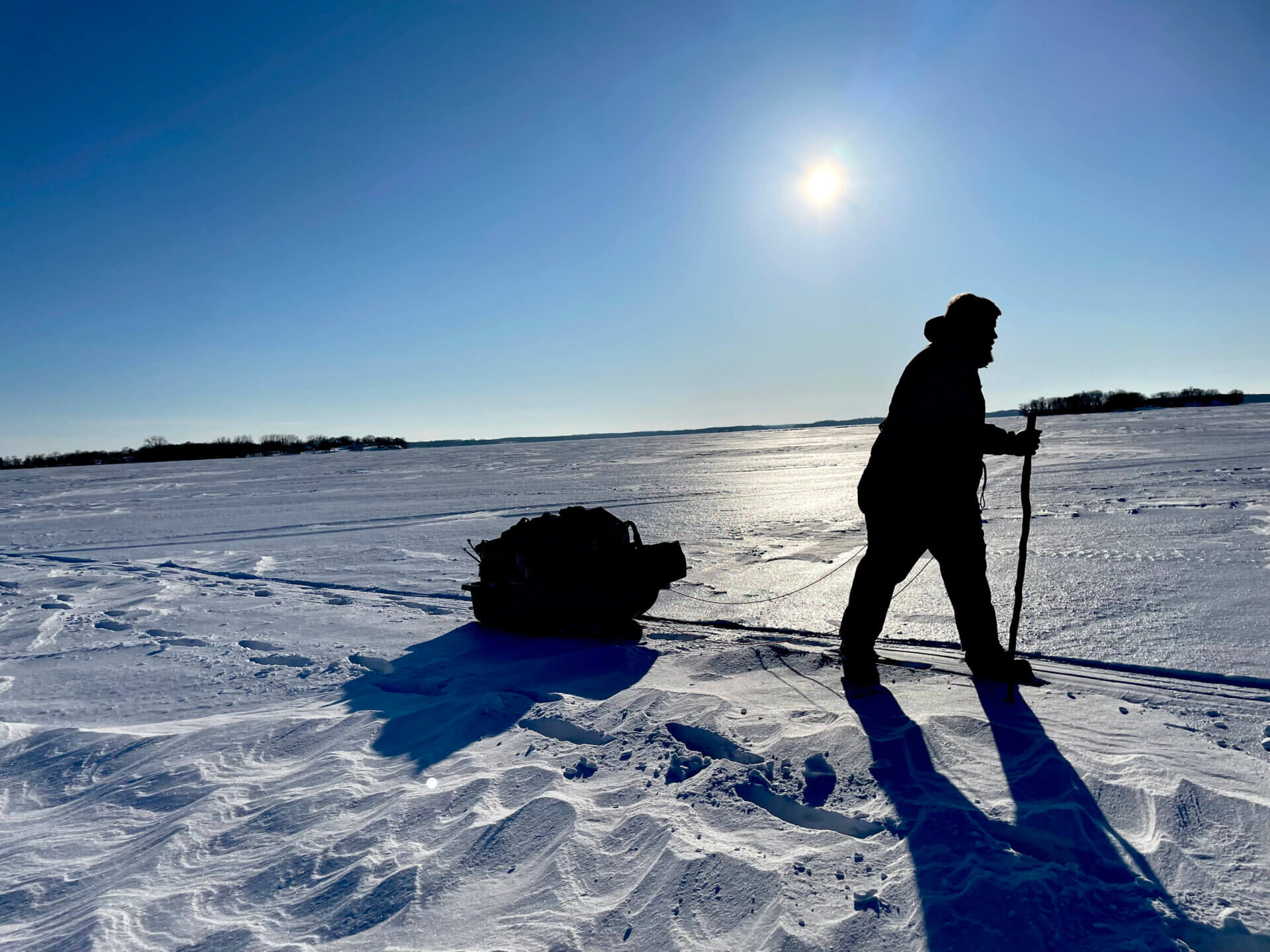
Majors got to renew his love for the natural beauty of southeast Kansas, ripping me along dirt roads in a side-by-side, and I got to remember the novelty of walking on a frozen lake for the first time. Honestly, the weather and not anything else may be the biggest difference between our towns!
About the Author
Benjamin Velani is the Lead for America Climate Fellow and serving AmeriCorps member at West Central Initiative. He recently graduated Summa Cum Laude from Cornell University, majoring in Religious Studies and Government and writing an undergraduate thesis on the human and ecological effects of light pollution and dark night skies. He was formerly the Dining Editor at The Cornell Daily Sun, and he’s now taking the lead on West Central Initiative’s Climate Action Newsletter.