
Ken Pentel is the Director of the Ecology Democracy Network and has been working for years to pass legislation that would allow Minnesota to calculate the Genuine Progress Indicator (GPI). Deeply passionate about this issue for the countless ways that such macroeconomic figures have real impacts on people’s everyday budgets, Pentel helps break down what the GPI is and how it differs from the dominant Gross Domestic Product (GDP) measurement of economic well-being.
Can you briefly explain what the GPI is?
The Genuine Progress Indicator (GPI) is an alternative composite number of an economy’s well-being for use instead of the Gross Domestic Product (GDP). The GPI meets the scale and takes into account far more indicators of true economic and social well-being than the GDP does.
What are your indicators of true economic well-being?
One is the health of your habitat. That’s one thing the GPI takes into account that’s so important. The GPD only sees value in a forest when it’s cut and turned into timber or chip wood. In the GPI, forests are valuable in and of themselves, fixing carbon, fixing soil, filtering water, filtering air, habitat for birds. So, where the GDP doesn’t care about what’s known as ecological services, the GPI does.
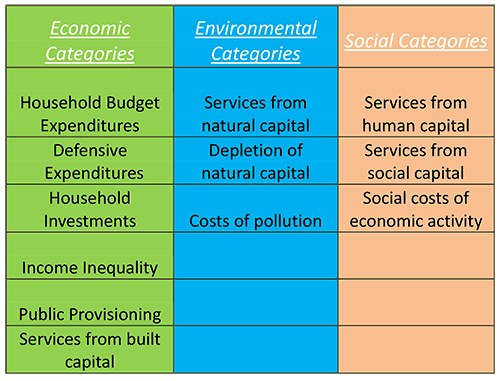
What kinds of considerations does the GPI include that are taken for granted in our current economy?
The GDP is calculated from local to the state to the national to the global level, and GDP is considered the most powerful economic signal on Earth. It’s what everyone’s chasing, and it sets pricing, interest rates, and budgeting. If we have two negative quarters of GDP, it’s a benchmark for a recession. GDP is designed around a growth imperative based on single-entry bookeeping. So, it basically just shows addition – an aggregate number of credits in the economy, or where, when, and how much money gets spent in a quarter. The GPI, on the other hand, shows credits and costs on the spreadsheet.
The GPI recognizes pollution as a cost to economy, whereas the GDP generally sees it as a credit, or it’s not calculated at all. The GPI, unlike the GDP, recognizes a variety of non-monetized activity, like housework, volunteerism, and the health of habitats. The GPI also cares about the equitable allocation of resources and sees economic inequalities as a cost for society.
Why should we consider those non-monetized costs?
The reason I think people should care is with the GPI you get a more accurate accounting of the overall well-being of our society. For example, in the GDP, whatever money is spent to pollute a water system shows up as a credit, and then whatever money is spent on clean-up and resource management also shows up as a credit. Policy makers need an accurate picture of the economy, so you’d want an economic measurement that considers pollution clean-up a cost and not a credit for society. The GPI provides this more accurate picture of credits and costs to society from all sources of activity.
How would changing one of our society’s greatest measurements of value directly affect the people of west central Minnesota?
The way the GDP works now, it undervalues rural economies and overvalues urban and suburban economies. Over the last 80 years, we’ve seen it here in Minnesota, but it’s also endemic all over the planet – populations migrate from rural to urban, leading to ballooning central cities and incredible stress in rural economies. The GPI would reverse this, and there’s several moving parts as to why this would happen.
For example, Minnesota spends anywhere between $15 and $18 billion out of state, on coal, oil, uranium, gas, and big hydro, and we bring those fuels into the state. Once we do that, we have to manage those fuels. Currently, the state uses the GDP to calculate its forecast and budget that affect rural economies. All the money spent doing remediation for the social and environmental costs of fossil fuels shows up as a credit, when in fact that’s money we spend to protect ourselves and save lives, and they should be considered a cost.
Let’s imagine a case where what’s coming out of tailpipes in the Twin Cities metro is causing acute asthma, and a young child ends up in an emergency room. Money’s being spent on dealing with this asthma in a variety of ways, and all that money shows up as credit on the GDP spreadsheet, when in fact it should and would be a cost on the GPI spreadsheet.
Once you shift from a credit to a cost on the spreadsheet, which the GPI does, you change incentives, and you change behavior. Now it becomes less attractive to send millions of dollars out of Otter Tail County to meet energy demands, and far more attractive to localize those dollars in efficiency and renewability by building self-sustaining grids. This will stabilize struggling rural economies because dollars will be staying in those communities, reinvesting in themselves and creating the types of jobs that we need to flourish.
About the Author

Benjamin Velani is the Lead for America Climate Fellow and serving AmeriCorps member at West Central Initiative. He recently graduated Summa Cum Laude from Cornell University, majoring in Religious Studies and Government and writing an undergraduate thesis on the human and ecological effects of light pollution and dark night skies. He was formerly the Dining Editor at The Cornell Daily Sun, and he’s now taking the lead on West Central Initiative’s Climate Action Newsletter.