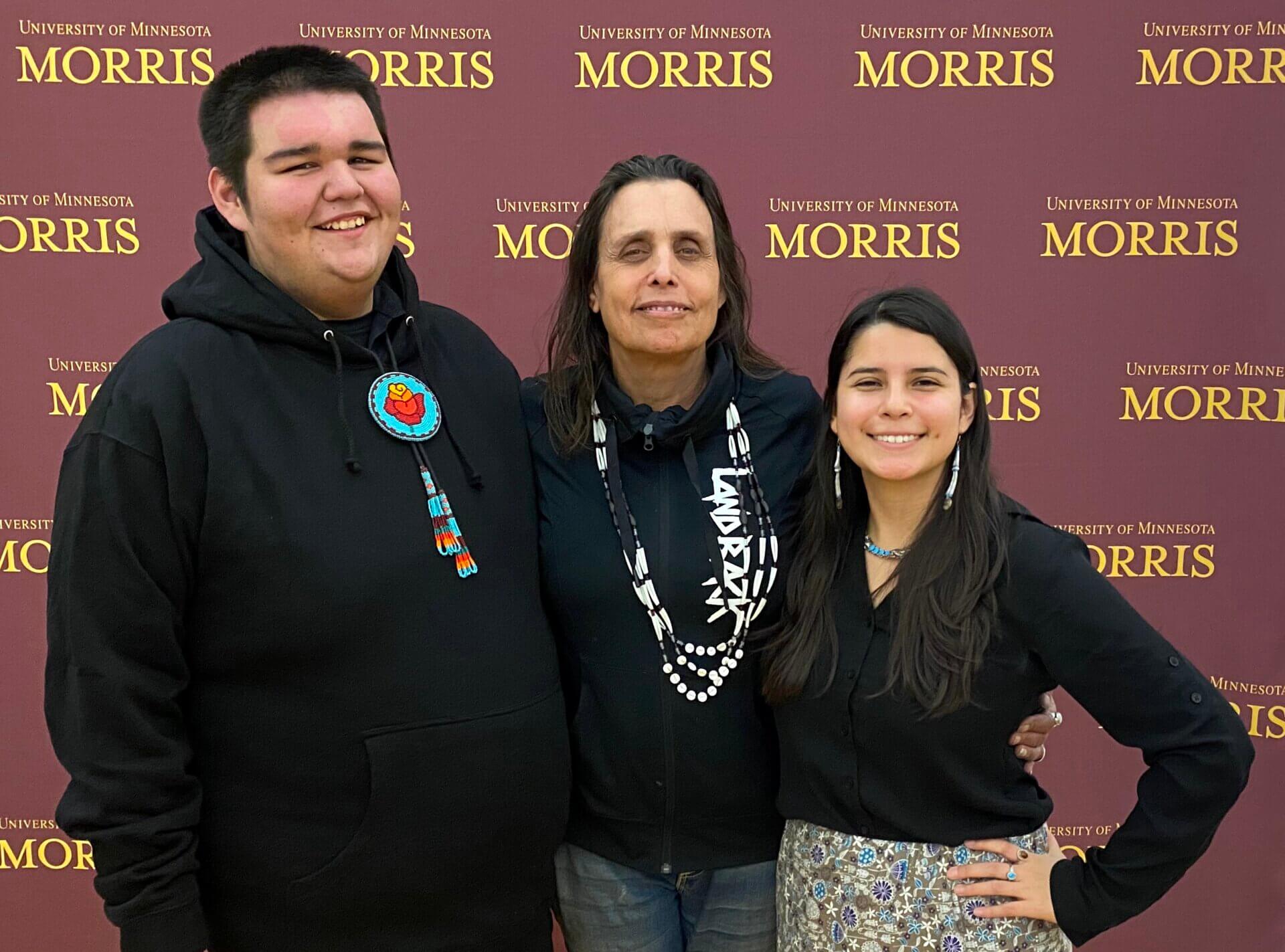
Each academic year on the University of Minnesota Morris (UMN Morris) campus, the Morris Campus Student Association’s (MCSA) sustainability officer leads the planning effort for an annual Sustainability Forum. The officer works with a team of peers, and together they coordinate presentations from storytellers that highlight the resiliency work happening across the Morris campus and community. Each year has a different theme.
The 2022-23 Sustainability Forum was spearheaded by MCSA Sustainability Officer Amalia Galvan, a third year at Morris majoring in environmental science and Native American and Indigenous studies. Galvan, a member of the White Earth Nation herself, chose to focus on uplifting Indigenous voices within the broader theme of environmental justice.
“I think my interest in tying those themes together sparked from some of the classes I’ve been taking,” Galvan said. “I took a class called ‘Intro to Sustainability through Sci-Fi,’ taught by Professor Clement Loo. It was in that class that I learned about the pillars of sustainability, and I’ve been building on that knowledge since.”
Galvan was mentored by another regional climate hero: Troy Goodnough, Sustainability Director at Morris. This was Galvan’s first time planning an event this large. Goodnough is a seasoned community convener and planner, leading and supporting much of the innovative climate action Morris has undertaken to become a national model for community sustainability.
“I listened and got a lot of input from other student event coordinators across campus on how to run the forum,” Galvan said, “and as the coordinator of all that activity, I had to synthesize all those ideas and organize them in a way I thought would best allow us to build out the theme and reach my goals for the event.”
Galvan would often talk things through with MCSA President Dylan Young, a mentor of hers, and Noelle Muzzy, vice president of the Morris student body. “I kept asking them, ‘what goal are we trying to accomplish?’ to bring us back to that higher purpose that united us all,” she said. “That goal is to get a lot of people together to celebrate Indigenous perspectives of sustainability.”
An important part of achieving that goal, Galvan explained to me, is finding the right presenters to speak to the theme of environmental justice, while uplifting Indigenous voices. “At the beginning of the planning process, I started ambitiously by asking who are the biggest names in this field we could ask to come to campus,” said Galvan. “Young threw up the idea of asking Winona LaDuke to come speak, and we all agreed. OK, let’s start at the top and go from there.”
Not only did Galvan and her team secure LaDuke as their keynote speaker, they also hosted Dr. Michelle Montgomery, associate professor of social and historical studies at the University of Washington, Tacoma, Dr. Teresa Peterson, author of Voices from Pejuhutazizi: Dakota Stories and Storytellers and Grasshopper Girl, and Gwe Gasco, sales and marketing director of 8th Fire Solar.
To fund the event, Galvan spent tireless hours emailing different student groups, campus offices, nonprofits, and private funds to secure eight major sponsors. Additionally, Galvan, with the help of students in Morris’s sustainability club, applied for and received funding from a Sustainable Development Goals (SDGs) Student Activity Grant.
Galvan focused on SDGs #6, #7, #13, and #16 because they most aligned with the forum’s speakers, themes, and intentions. #6: Clean water and sanitation. #7: Affordable and clean energy. #13: Climate action. #16: Peace, justice, and strong institutions. Strong goals rooted in principles on which all can find agreement, the SDGs offer a framework for sustainable development that is quickly being adopted around the world as a common language for this kind of work.
As such, West Central Initiative has, since 2019, been aligning its regional development and philanthropy work with the SDGs to promote a more sustainable and resilient Minnesota. The organization also maintains a regional SDG Dashboard, updated annually, to track how our region is addressing the 17 goals.
About the Author
Benjamin Velani is the Lead for America Climate Fellow and serving AmeriCorps member at West Central Initiative. He recently graduated Summa Cum Laude from Cornell University, majoring in Religious Studies and Government and writing an undergraduate thesis on the human and ecological effects of light pollution and dark night skies. He was formerly the Dining Editor at The Cornell Daily Sun, and he’s now taking the lead on West Central Initiative’s Climate Action Newsletter.