Like many small rural towns, Farwell, Minnesota, was a victim of the times.
A place that long ago had all the bustle of small-town life – a thriving train depot, dry goods store, hotel, restaurant, bank, lumber yard – Farwell suffered much the same fate as other rural places – demographic shifts and economic realities. Not a ghost town by any means, but let’s just say there weren’t many reasons to visit anymore. That’s reality in a rural town of less than 100 people.
But today, there are many reasons to visit.
Passionate about history? You’ll love the old country schoolhouse, the Norwegian church resurrection, and the funky repurposed buildings, all of which are just moments apart.
Love the arts? The whole reawakening of Farwell features artists, their work, and the aforementioned venues, all perfect for weddings, meetings, live performances and special events.
Yes, you’ll want to visit this place now!
It’s a story that gives inspiration to other rural communities, a story that developer Ted Irgens and artist-turned-promoter Gloria Pfeifer willingly share. They want people to see what’s happening in this great little town.
It’s a story of revitalization.
Answering the Opportunity Knock
Ted Irgens grew up in Alexandria and has a lake place there. He lives and works in the Twin Cities. In 2017, his life path took a turn.
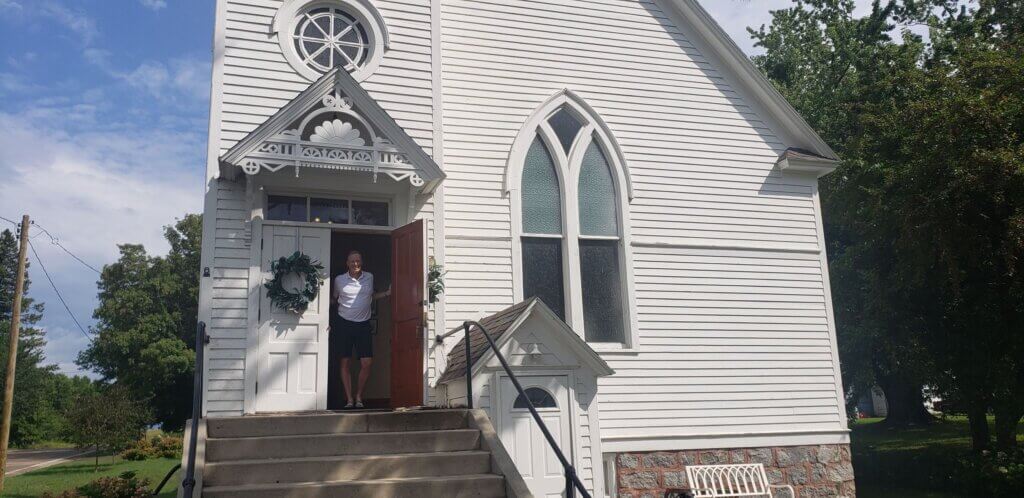
“A friend of mine from high school, who owned the church in Farwell, said she was going to sell the church and suggested that I buy it,” Ted said.
The church was in bad shape, abandoned for over 20 years, with a partially fallen roof, water damage, a steeple that needed help, and much, much more. So why did Ted take a flyer on the project? Did Ted’s friend know he had a connection to Farwell, that his great grandparents and grandparents all lived there? Did someone know Ted had the right character and disposition to get take on a big renovation?
“I thought it was a weird project, but it would be fun. I’ve always loved old buildings,” he said. “I grew up in a 110-year-old house with my six siblings and my parents. So, I kind of had an affinity for old buildings, but I thought the church would be one and done.”
As we’ll find out, it wasn’t.
“I’ll redo this church, I’ll figure it out,” he recalls. “I thought it would be used for weddings and events, and it has, as well as many concerts and a few baptisms.”
Ted was introduced to Gloria, a local artist, who came on board to help bring the church back to its roots. She became instrumental in the project when she took on the challenge of restoring the original 1907 stenciling that was discovered on the walls and ceiling when insulated tiles were removed. “I knew I could do the work,” Gloria explained. “There was a lot to do. I like challenges,” she said. “Ted was kind of advertising for an artist. I understand he first thought house painters could do it, and they said no way.”
Ted laughs. “She was fantastic. There she was, three stories up on scaffolding, on her back painting stencils – like Michelangelo!” They both laugh. And Gloria notes with a smile that at that moment she was on break. “I did most of the painting standing up on planks.”
You might think bringing a church back to its heritage, to its 1907 roots, was the capstone project. Indeed, the first public showing, following the bulk of the renovation, was a Christmas bizarre. Hundreds of people stopped by, way more than expected. Ted said he stood in one spot for the whole time but did catch Gloria’s eye during the festivities.
The look was “what just happened?”
But it didn’t stop there.
Renovating Old Buildings
Ted explains, “While we were doing the church project, I received a letter in the mail from some wonderful people down the road, who had a one-room schoolhouse. It had been a carve-out on a farm for years. At one time, it had been used as a town hall.”
“When they bought it for the land, they didn’t want to tear it down and asked if we would like to have it. So they donated it, we moved it into town, right across the street from the church; it makes a perfect compliment.”
The lot was purchased from the city, the 1886 country schoolhouse was renovated, and in 2018 it opened as an art gallery. Today you not only have a peek into our educational history, but a different artist sets up a show of their work, for discussion and sale, each month.
Yet more opportunities appeared. Ted purchased the corner garage, a landmark building in the middle of Farwell that had been in the same family for decades. The old creamery also became available. Both were priced right because the buildings needed lots of work (the gas station needed a new roof and floor, and some windows, the creamery needed to be mostly gutted and rebuilt, with new plumbing, electrical, windows and doors. As much of the original was saved as possible, too.
One of the keys to this venture is that everything is within easy walking distance and this year became connected through a series of gardens. The cluster of buildings as public venues became something of a vision for the future, shared by both Ted and Gloria, plus a host of other community folks.
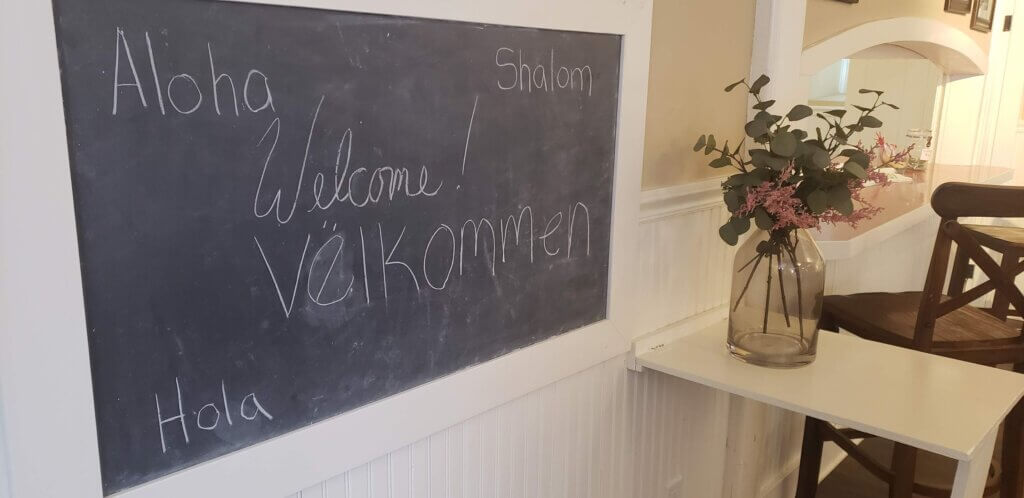
And they do give a lot of credit to the people of Farwell.
“We could see the potential for arts and music, and even for the community to have fun activities to do right there in town,” Gloria said. “Farwell’s wonderful community center is used a lot, which tells you that people here want to gather. They gave us so much encouragement.”
Gloria admits that there were a lot of unknowns when the projects kept popping up. So, she’s philosophical about it.
“We don’t know if it will be successful or not, but how do you know if you don’t try?”
It’s paid off so far. A public radio story (link to article) featured the new lease on life for the old buildings, which garnered interest throughout the state. More artists are lining up to participate and a full schedule of concerts and events can be found on the Farwell Norwegian Church Facebook page (link to page). Gloria remembers doing a social media call-out for artists and crafters, filling up the open calendar spots in just two days.
In the meantime, a non-profit arts organization, The Farwell Community Arts Association (FCAA), is now being organized to run future programming and planning for the 2023 season.
Farwell is once again ready for visitors.